If you’re used to exercising regularly, one of the first questions that may come to mind after liposuction is, “When can I get back to my normal workout?”
It’s a completely understandable concern. You may feel surprisingly good a few days after surgery and start wondering whether it’s safe to return to the gym. At the same time, you don’t want to rush your recovery or do anything that could interfere with your results.
The good news is that you don’t have to stop moving completely. In most cases, gentle walking is introduced early, while more demanding activities such as running, weight training and high-intensity workouts are brought back gradually.
So, when can you walk after liposuction? When can you run? And when is it safe to return to the gym and lift weights?
Here’s what you need to know.
The Short Answer
Light walking is usually encouraged early after liposuction, provided your surgeon has advised that it is appropriate for you.
More strenuous exercise takes longer. Running, heavy weightlifting, intense cardio and demanding gym workouts should generally wait until your body has had enough time to heal and your surgeon has cleared you to resume them.
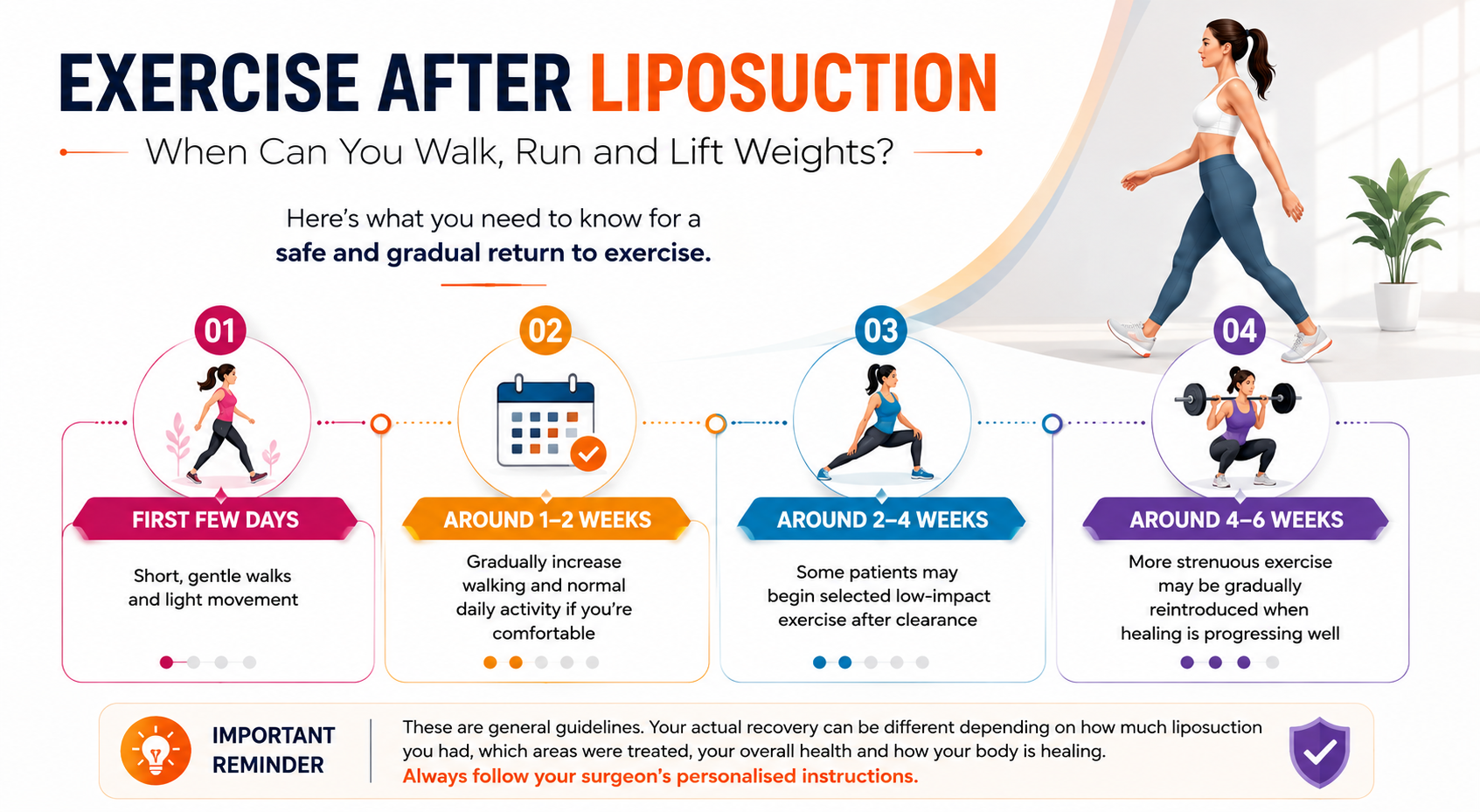
A general recovery pattern may look something like this:
- First few days: Short, gentle walks and light movement
- Around 1–2 weeks: Gradually increase walking and normal daily activity if you’re comfortable
- Around 2–4 weeks: Some patients may begin selected low-impact exercise after clearance
- Around 4–6 weeks: More strenuous exercise may be gradually reintroduced when healing is progressing well
These are only general guidelines. Your actual recovery can be different depending on how much liposuction you had, which areas were treated, your overall health and how your body is healing.
Your own surgeon’s instructions should always take priority over a general timeline.
Why Can’t You Exercise Normally Straight Away?
It can be tempting to think that if you’re feeling well, you’re ready to exercise.
But recovery isn’t only about how you feel on the outside.
Liposuction creates changes in the tissues beneath the skin, and your body needs time to heal. Swelling, bruising and tenderness can continue even when you feel capable of doing more.
Pushing yourself too hard too early may increase discomfort and swelling and can make the recovery period more difficult.
That’s why returning to exercise should be viewed as a gradual progression rather than a race back to your old routine.
When Can You Walk After Liposuction?
Walking is usually the first activity patients are encouraged to resume.
In the early days, this doesn’t mean going for a long walk or trying to hit your usual step count. The goal is simply to get up and move gently.
Short walks around your home may be enough initially.
As you feel better, you can gradually increase how often and how long you walk.
Listen to your body. If a particular increase in activity leaves you significantly more swollen, sore or uncomfortable, that’s a sign to slow down and discuss your progress with your surgical team if needed.
Gentle movement can be an important part of recovery, but it should not feel like a workout in the early stages.
When Can You Start Walking Longer?
Once short walks become comfortable, you can gradually build up your walking time.
You don’t need to increase your distance every day.
For example, if a short walk feels comfortable one day but leaves you noticeably more swollen afterward, give your body more time before increasing the distance.
Recovery isn’t always perfectly linear. You may have a good day followed by a day when you feel more tired or swollen.
That’s normal.
The goal is to gradually return to your usual level of activity without repeatedly pushing beyond what your body can comfortably handle.
When Can You Run After Liposuction?
Running is considerably more demanding than walking.
It involves repeated impact and greater movement of the muscles and tissues around the treated areas. For this reason, running usually needs to wait until you’re further along in your recovery.
Before returning to running, you should generally be comfortable with walking and normal daily activities without significant pain or worsening swelling.
Once your surgeon clears you, don’t feel that you need to return to your old pace immediately.
Start with a short, easy session and see how your body responds.
If everything feels comfortable, you can gradually build up your distance and intensity.
When Can You Go Back to the Gym After Liposuction?
The answer depends on what you mean by going back to the gym.
Walking slowly on a treadmill is very different from doing:
- Heavy squats
- Deadlifts
- HIIT
- Heavy resistance training
- Intense cycling
- Abdominal exercises
- High-impact cardio
So instead of asking only, “When can I go to the gym after liposuction?”, it is more useful to ask:
“Which exercises are appropriate for me at this stage of recovery?”
You may be ready for light activity before you’re ready for a full gym session.
What Does a Workout After Liposuction Look Like?
Your workout after liposuction should gradually become more challenging as your recovery progresses.
Think about it in stages.
Early recovery: Gentle movement
Your focus is on short walks and normal daily movement.
Building activity: Longer walks
As your comfort improves, gradually increase your walking.
Returning to exercise: Light activity
Once your surgeon clears you, you may begin selected low-impact exercises that don’t place excessive strain on the treated areas.
Returning to your routine: More intense exercise
Running, heavy resistance training, HIIT and other demanding workouts should be introduced only when your recovery allows.
There’s no benefit in forcing yourself through every stage as quickly as possible.
Your body doesn’t get extra points for being the fastest to return to the gym.
When Can You Lift Weights After Liposuction?
Weight training requires particular care because lifting can place significant strain on the body.
Some exercises also involve bracing your abdominal muscles or repeatedly moving areas that have been treated.
For this reason, heavy lifting is generally avoided during the early recovery period.
Once your surgeon clears you to begin resistance training, start conservatively.
You may want to begin with:
- Lighter weights
- Fewer repetitions
- Shorter sessions
- Longer rest periods
Then gradually work your way back toward your usual routine.
If you normally lift heavy weights, don’t assume that you should immediately return to your previous training load simply because your incisions look healed.
The tissues underneath are still recovering.
What About Ab Workouts After Abdominal Liposuction?
If you’ve had liposuction around your abdomen, you may be especially eager to get back to your core routine.
That might include:
- Crunches
- Sit-ups
- Planks
- Leg raises
- Heavy compound lifts
- Other exercises that require significant abdominal bracing
These movements can place stress on healing tissues.
Your surgeon should tell you when it is appropriate to restart abdominal training. When you do return, gradually increase the intensity rather than immediately performing your full pre-surgery routine.
What If You Had Liposuction on Your Arms?
The recovery considerations can be slightly different depending on the area treated.
If you’ve had arm liposuction, exercises involving the upper body, resistance training and repeated arm movements may need to be modified while the area heals.
If you’re specifically considering or recovering from arm liposuction, our FAQs about arm liposuction in Mumbai can help answer some of the questions patients commonly have about the procedure.
Your own surgeon can then give you personalised instructions based on the extent of treatment and your recovery.
Can Exercise Affect Your Liposuction Results?
Once you’ve recovered, regular exercise can be an important part of maintaining a healthy, stable weight.
Liposuction removes fat cells from the treated areas, but it isn’t a replacement for a healthy lifestyle. The remaining fat cells can still enlarge with significant weight gain.
This is one reason maintaining your results isn’t simply about what happens during surgery.
Liposuction is a body-contouring procedure rather than a weight-loss treatment, and the results develop gradually as swelling settles.
If you’d like to understand more about what liposuction can and cannot do, our guide on why liposuction is used as a fat-removal and body-contouring method explains the procedure and the importance of maintaining a healthy lifestyle after treatment.
Does Exercising Too Soon Make Liposuction Results Better?
No.
It’s understandable to think that getting back to exercise quickly might help you see your new body contour sooner.
But your body doesn’t need an intense workout to “activate” your liposuction results.
The final contour develops as your body heals and postoperative swelling gradually settles. The source material on the clinic’s site also notes that liposuction results are not immediate and can continue to develop over weeks to months.
During early recovery, your priority should be healing, not trying to accelerate the final result through exercise.
What Happens If You Exercise Too Soon?
You may feel fine and still be doing more than your body is ready for.
Returning to strenuous exercise too early can contribute to increased:
- Swelling
- Bruising
- Soreness
- Discomfort
- Fatigue
It can also make it harder to tell whether a new symptom is part of normal recovery or something that needs to be checked.
If your surgeon has given you specific restrictions, follow them even if you feel ready to do more.
How Do You Know You’re Ready to Increase Exercise?
There’s no single symptom that can tell you you’re ready for every type of exercise.
Instead, your recovery should be progressing steadily.
You should be comfortable with your current level of activity before increasing it further. Your surgeon may also want to assess your incisions, swelling and overall healing before clearing you for more strenuous exercise.
And remember:
Being cleared to exercise doesn’t mean you need to exercise at 100% intensity on day one.
Start slowly and build up.
What About Compression Garments and Exercise?
Many patients are advised to wear compression garments following liposuction.
Your surgeon may recommend them to support the treated areas during recovery and provide specific instructions about how long and when to wear them.
However, wearing a compression garment doesn’t automatically mean you’re ready for strenuous exercise.
Follow the instructions you’ve been given, and if you’re unsure whether you should wear it during a particular activity, ask your surgical team.
What If You Feel Completely Fine After a Few Days?
This is one of the easiest times to overdo things.
Some patients feel much better within a few days and naturally want to return to their normal routine.
But feeling better doesn’t necessarily mean that your body has finished healing.
You may still have swelling and tissue recovery happening beneath the surface.
So, even if you’re feeling energetic, give your body the time it needs.
A few extra days or weeks of patience are much easier to manage than dealing with unnecessary discomfort because you pushed too hard.
Common Myths About Liposuction Recovery
There is a lot of conflicting information online about liposuction, including claims about how quickly you can return to exercise, how soon you’ll see results and whether the removed fat can come back.
For example, liposuction is not a weight-loss procedure, and final results don’t appear immediately because swelling and tissue changes take time to settle.
If you’ve come across advice that sounds too good to be true—or simply aren’t sure what to believe—our article on common liposuction myths and what the evidence actually means is a useful place to start.
When Should You Contact Your Surgeon?
Some swelling, bruising and discomfort are expected after liposuction.
But don’t simply try to exercise through symptoms that seem unusual or are getting worse.
Contact your surgical team if you notice concerning symptoms such as:
- Increasing rather than improving pain
- Sudden or significant swelling
- Persistent bleeding
- Fever
- Increasing redness around an incision
- Concerning fluid drainage
- Shortness of breath or chest pain
If you develop severe or sudden symptoms, seek urgent medical attention.
Final Thought
Getting back to exercise after liposuction isn’t about finding one magic date.
It’s about giving your body enough time to heal and gradually rebuilding your activity level.
Walking is generally introduced much earlier than running or heavy weight training. Returning to the gym should also happen in stages, because a light treadmill walk and a heavy strength-training session place very different demands on your recovering body.
Most importantly, don’t compare your recovery with someone else’s.
The amount of liposuction, areas treated, your general health and your individual healing can all influence how quickly you can return to exercise.
If you’re eager to get back to your normal routine, that’s completely understandable. Just remember that recovery is part of the procedure too.
Give your body time, listen to your surgeon, and let your return to exercise happen gradually.

Frequently Asked Questions
Q. How soon can I exercise after liposuction?
Gentle walking is often introduced early, but strenuous exercise generally needs more time. Your surgeon will advise when you can safely progress from walking to more demanding activities.
Q. When can I go to the gym after liposuction?
It depends on the type of exercise you want to perform. Light activity may be introduced earlier, while running, HIIT and heavy resistance training generally require a longer recovery period and clearance from your surgeon.
Q. When can I run after liposuction?
Running usually needs to wait until your recovery has progressed sufficiently. You should be comfortable with walking and normal daily activities before returning to higher-impact exercise, and your surgeon should clear you to do so.
Q. When can I lift weights after liposuction?
Heavy weightlifting should generally be avoided during early recovery. Once cleared for resistance training, gradually increase the weight and intensity rather than immediately returning to your previous training level.
Q. Can I walk after liposuction?
Gentle walking is commonly encouraged during recovery, often beginning soon after surgery if your surgeon considers it appropriate. Start with short walks and increase your activity gradually.
Q. Can exercise ruin liposuction results?
Exercise after you’ve recovered does not ruin liposuction results. Regular physical activity and maintaining a stable weight can support your long-term body contour. However, strenuous exercise too early may increase swelling and discomfort.
Q. Can I do abdominal exercises after abdominal liposuction?
Exercises such as crunches, planks and heavy lifting can place strain on healing tissues. Wait until your surgeon gives you clearance before returning to intensive abdominal workouts.
Q. Is it normal for swelling to increase after exercise?
Some temporary swelling may occur as you become more active, but significant or persistent worsening swelling should be discussed with your surgical team.
Q. How long before I can return to my normal workout routine?
There isn’t one timeline that applies to everyone. Your return to normal exercise depends on the extent of your procedure, the areas treated and how your body is healing. Your surgeon should clear you before you resume strenuous workouts.
Q. Is liposuction a weight-loss procedure?
No. Liposuction is primarily a body-contouring procedure designed to remove localised areas of fat that may be resistant to diet and exercise. It should not be considered a substitute for weight management.
Q. Can I lose more weight by exercising soon after liposuction?
Liposuction isn’t intended to be a weight-loss treatment. Trying to accelerate weight loss through intense exercise during early recovery isn’t recommended. Once you’ve healed, regular exercise and a healthy lifestyle can help support your overall health and maintain your body contour.
Q. Do I need to follow a specific exercise plan after liposuction?
Your surgeon may recommend a gradual activity plan based on your procedure and recovery. Because every patient heals differently, personalised instructions are more useful than following a generic workout schedule found online.
Medical Disclaimer: This article is for general educational purposes and does not replace an individual medical consultation. Recovery timelines and exercise restrictions can vary from patient to patient. Always follow the specific instructions provided by your plastic surgeon.